
Why Are Suspension Insulators Used in Power Lines?

Time:2026-10-03 Author:Amelia
0%

Suspension Insulator assemblies support overhead conductors while electrically separating them from steel towers. Their role becomes critical as transmission networks carry higher voltages across longer distances. According to the International Energy Agency’s Electricity 2024 report, global electricity demand is expected to grow strongly through 2026. More generation will require dependable transmission infrastructure. The insulator is a small component, but its failure can interrupt an entire circuit.

A Suspension Insulator uses a string of porcelain or toughened glass units. Each unit shares the electrical stress and mechanical load. The conductor hangs below the cross-arm, allowing the tower to remain at ground potential. This arrangement provides flexibility during line construction and maintenance. Utilities can add or remove discs when voltage levels change. The IEC 60383-1 standard defines key mechanical and electrical requirements for cap-and-pin insulator units used on overhead lines. CIGRE technical guidance also emphasizes pollution, moisture, ice, and switching overvoltage as practical design concerns.

The decision is not simply about choosing the strongest product. That explanation is incomplete. A field engineer must consider altitude, salt deposits, wind, conductor weight, hardware corrosion, and washing practices. In coastal air, a clean-looking insulator may still develop a conductive surface film. That detail matters. The IEA’s Grids and Secure Energy Transitions report estimates that more than 80 million kilometres of grids must be added or upgraded globally by 2040. This expansion increases demand for reliable components and disciplined inspection. Suspension insulators offer proven performance, yet they are not maintenance-free. Design margins, testing, and periodic condition assessment remain essential for safe, resilient power delivery.
Why Are Suspension Insulators Used in Power Lines?

What Are Suspension Insulators?

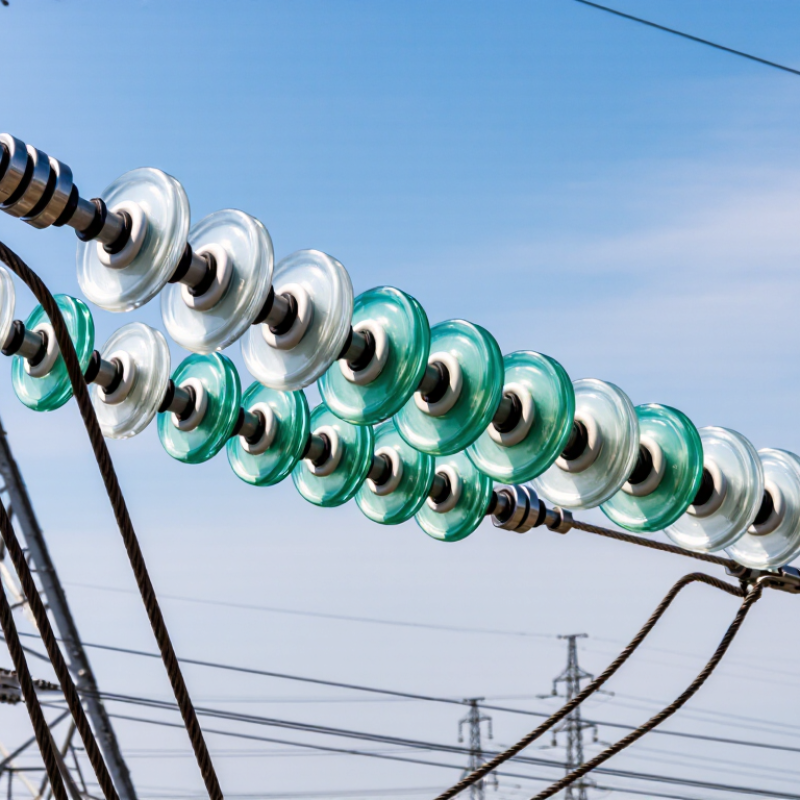
Suspension insulators are components that support overhead conductors while keeping electricity away from steel towers. A single unit usually contains a porcelain, glass, or polymer insulating body. Metal fittings connect it to the tower above and the conductor below. Several units form an insulator string. Higher voltages usually require longer strings and greater insulation distances.

Their design allows the conductor to hang safely from a crossarm. It also helps distribute mechanical tension along the line. During wind, ice, or sudden load changes, the string can swing slightly without losing its insulating function.

The outer sheds increase the creepage distance. This longer surface path helps reduce leakage current when dust, salt, or moisture covers the insulator.

In practical inspections, a clean-looking surface is not always healthy. Small cracks, loose fittings, or dark tracking marks may indicate electrical stress. I have also noticed that pollution can collect beneath the sheds, where a quick visual check may miss it. Weather and local contamination must guide maintenance decisions. That part is easy to underestimate. Suspension insulators are widely used because they combine electrical isolation, mechanical support, and adaptable construction for long-distance power lines. Their performance still depends on correct installation and regular inspection.

How Are Suspension Insulators Designed and Installed?

Suspension insulators are designed as linked units, not as one oversized component. A single porcelain or toughened-glass disk commonly serves about 10–15 kV, depending on pollution and operating conditions. Engineers add disks for system voltage, switching surges, and lightning impulses. IEC 60815-1 divides pollution into four site-severity levels, guiding creepage distance and surface design. Salt, dust, and industrial deposits can increase the required distance sharply. Small details matter.

Installation begins with a structural and electrical check. Crews verify tower loading, conductor weight, wind pressure, and the string’s swing angle. Hardware must align freely, without forcing the clevis or damaging the cap. IEEE insulation-coordination guidance uses the 1.2/50 microsecond lightning impulse when checking clearances. Field teams also inspect each disk for cracks, chips, contamination, and loose fittings before lifting the string. Corona-control rings may be fitted at higher voltages to reduce electric-field concentration. CIGRE Technical Brochure 549 emphasizes that pollution performance depends strongly on local exposure, not only rated voltage. That is easy to underestimate. A clean laboratory string can behave differently beside a coastline or cement plant. Installation records should include torque checks, weather conditions, photographs, and measured clearances. In practice, maintenance planning is sometimes less precise than the original design. That weakness deserves attention.

Why Are Suspension Insulators Used in Power Lines?

Suspension insulators support overhead conductors while electrically isolating them from towers and crossarms. The string length increases with system voltage, and the final design also depends on pollution level, altitude, lightning performance, mechanical loading, and required creepage distance.

The chart shows representative numbers of standard cap-and-pin suspension units commonly considered for different transmission-voltage classes. These are indicative engineering values rather than universal rules; utilities select the final string configuration after insulation-coordination and mechanical-design calculations. During installation, units are assembled into a string, attached to the tower hardware, and the conductor is connected through the lower fitting and clamp.

How Do Suspension Insulators Support Power Lines?

Suspension insulators support overhead conductors while keeping electricity away from steel towers and grounded structures. They hang below the crossarm, creating a flexible connection between the tower and the wire. This arrangement helps the line carry heavy conductors across long spans.

Each insulator unit uses a strong insulating body, usually made from tough glass, porcelain, or composite material. Several units connect in a string. More units provide a longer electrical path and greater resistance to high voltage. The string also shares mechanical tension from the conductor, especially near rivers, roads, and uneven terrain.

During a line inspection, engineers check for cracks, contamination, loose fittings, and unusual movement. Dust and salt can form a conductive film on the surface. Rain may wash it away, but not always. The metal hardware must also hold the conductor securely during wind, ice, and temperature changes. A damaged unit can increase electrical stress on neighboring units. That weakness may not be obvious from the ground.

Suspension systems are practical, but they are not perfect. Engineers must balance insulation length, tower strength, weather exposure, and maintenance access. Small design assumptions can matter. A reliable line depends on careful testing, installation, and repeated inspection over many years.

Why Are Suspension Insulators Preferred for High-Voltage Transmission?

Why Are Suspension Insulators Used in Power Lines?

Suspension insulators are preferred for high-voltage transmission because they handle electrical stress more effectively. A string of porcelain or composite units hangs below the tower arm, supporting the conductor without creating a direct path to ground. Each unit shares part of the voltage, so engineers can add units for higher transmission levels. This modular structure also makes repairs more practical. A damaged unit can often be replaced without removing the entire string.

The physical arrangement matters. Hanging insulators provide greater clearance between the energized conductor and the tower. Their flexible connection can reduce mechanical stress when wind or ice moves the conductor. In routine inspections, technicians check for cracks, contamination, corrosion, and unusual discoloration. Salt, dust, and industrial pollution may form a conductive film on the surface. Regular washing or improved insulation design may then be required.

No design is perfect.

Suspension systems still need careful engineering. Engineers calculate voltage distribution, wind loads, conductor weight, and pollution levels before selecting the string length. Uneven voltage across individual units can increase electrical stress near the line end. Grading rings may help control this effect, but they do not remove every risk. Field conditions can also differ from laboratory assumptions. A line that performs well in clean weather may need closer monitoring after storms or in coastal areas. Reliable maintenance records, trained inspections, and testing against recognized electrical standards help keep these systems dependable.

What Factors Affect Suspension Insulator Performance?

Why Are Suspension Insulators Used in Power Lines?

Suspension insulators hold conductors away from towers while resisting electrical stress. Their performance depends on more than rated voltage. Surface contamination is a major concern. Dust, salt, cement particles, and industrial residue can collect on the insulating surface. When rain wets this layer, leakage current may increase and cause flashover. A clean insulator can behave very differently from one exposed to coastal fog.

Moisture, temperature, and ultraviolet exposure also influence long-term reliability. Repeated heating and cooling can create small mechanical stresses. In freezing climates, trapped water may expand inside defects. Engineers therefore examine local weather records, pollution levels, and washing practices before selecting an insulator string. Field inspections often reveal details that drawings miss. A loose fitting, damaged shed, or uneven conductor load can reduce safety margins.

Mechanical loading matters just as much as electrical insulation. Wind, ice, conductor tension, and vibration place continuous force on the hardware. Poor alignment may concentrate stress at one point. That weakness can remain unnoticed for years. Regular checks should look for cracks, corrosion, contamination, and unusual movement. Testing data is useful, but it is not perfect. Human judgment still matters, especially after storms or maintenance work. Sometimes, the smallest visible defect deserves the closest attention.

Why Are Suspension Insulators Used in Power Lines? - What Factors Affect Suspension Insulator Performance?
Performance Dimension Typical Engineering Data Why It Matters on Power Lines Main Factors Affecting Performance
Primary Function Supports the conductor mechanically while providing electrical insulation between the energized conductor and the grounded tower. Allows high-voltage overhead lines to maintain the required air clearances and safely transfer conductor loads to the structure. System voltage, conductor weight, wind load, ice load, span length, tower geometry, and required safety clearances.
Common Insulator Materials Toughened glass, porcelain, and polymeric composite materials are widely used for suspension strings. Each material offers a different balance of mechanical strength, contamination behavior, weight, impact resistance, and inspection requirements. Material quality, manufacturing defects, aging, ultraviolet exposure, moisture ingress, thermal cycling, and surface contamination.
Typical Number of Discs in a String Approximately 3–4 discs at 33 kV, 7–9 at 110 kV, 14–16 at 220 kV, and 20–24 at 400 kV. Actual values vary by design and standards. Increasing the number of units raises the string's withstand capability and creepage distance for higher system voltages. Highest system voltage, lightning impulse level, switching impulse level, pollution severity, altitude, and required safety margin.
Creepage Distance Common design values are roughly 16–31 mm per kV of the applicable insulation reference voltage, depending on pollution severity and the selected standard. A longer surface path reduces the risk of contamination flashover when salt, dust, industrial deposits, or wet pollution forms a conductive layer. Salt fog, industrial pollution, dust, bird contamination, rainfall, humidity, insulator profile, and surface hydrophobicity.
Mechanical Strength Common suspension-unit rated mechanical loads are approximately 70–300 kN; complete strings are selected for the calculated conductor and environmental loads. The string must withstand normal tension as well as short-duration forces caused by wind, ice, conductor movement, and exceptional events. Conductor tension, span length, wind pressure, ice accretion, broken-wire conditions, hardware alignment, fatigue, and mechanical damage.
Electrical Withstand Insulation coordination normally considers power-frequency withstand, lightning impulse withstand, switching impulse withstand, and contamination performance rather than one universal voltage value. The string must prevent flashover during normal operation and during temporary overvoltages, lightning events, and switching surges. Air density, altitude, electrode shape, voltage polarity, rain, contamination, corona, radio interference, and transient overvoltage magnitude.
Operating Temperature Line hardware is commonly specified for site temperatures ranging from about −40°C to +40°C, with some applications requiring wider limits. Temperature changes affect material expansion, seal condition, ice formation, conductor sag, and the mechanical loading of fittings. Local climate, solar heating, conductor current, thermal cycling, icing, wind chill, and material thermal expansion.
Altitude Effect At elevations above approximately 1,000 m, reduced air density can lower external insulation withstand and may require correction or increased clearances. The insulator surface itself does not lose all dielectric strength, but the surrounding air becomes less capable of resisting flashover. Site elevation, air pressure, humidity, conductor-to-tower distance, impulse type, and the applicable altitude correction method.
Pollution and Wetting Performance Clean, dry insulation has substantially higher surface resistance than insulation covered by a wet conductive deposit; pollution design is commonly classified from light to very heavy severity. Wet contamination can create leakage current, dry-band arcing, and eventually a complete flashover across the string. Equivalent salt deposit density, pollution type, deposit uniformity, rain intensity, fog, wind, washing frequency, and insulator profile.
Maintenance and Inspection Typical practices include visual inspection, infrared or ultraviolet inspection where appropriate, leakage-current monitoring, washing, and replacement of damaged units. Early detection of cracked units, corrosion, broken sheds, hardware damage, or abnormal discharge reduces unplanned outages. Accessibility, contamination level, lightning exposure, inspection technology, utility maintenance policy, and local failure history.
Engineering note: The values shown are representative planning ranges, not universal ratings. Final suspension-insulator selection should be verified against the applicable system voltage, insulation-coordination study, environmental conditions, and relevant standards such as IEC 60305, IEC 60815, IEC 61109, IEC 61466, and IEEE 4.

FAQS

What is the main purpose of a suspension insulator?

It holds an overhead conductor away from steel towers and grounded structures. It also resists electrical stress. This keeps power moving safely across long spans.

Why are several insulator units connected in a string?

Multiple units create a longer electrical path. They also increase resistance to high voltage. The string shares conductor tension near rivers, roads, and uneven ground.

What materials are commonly used in suspension insulators?

Insulating bodies usually use tough glass, porcelain, or composite materials. Each material has different strength and weathering behavior. Selection depends on voltage, climate, and mechanical demands.

How can dust and salt affect performance?

Dust, salt, cement particles, and industrial residue can build a surface film. Moisture may make that film conductive. Leakage current can rise, increasing the risk of flashover.

Does rain always clean an insulator?

No. Rain may remove contamination, but not completely. Coastal fog or light rain can leave a wet, conductive layer behind.

What weather conditions place stress on suspension systems?

Wind, ice, temperature changes, moisture, and ultraviolet exposure can reduce reliability. Freeze-thaw cycles may expand water inside small defects. Uneven loads can worsen the damage.

What do engineers check during an inspection?

They look for cracks, corrosion, contamination, loose fittings, damaged sheds, and unusual movement. They also examine conductor alignment and hardware condition. Ground views may miss hidden weaknesses.

Are suspension insulators completely reliable?

No system is perfect. Design must balance insulation length, tower strength, weather exposure, and maintenance access. Testing helps, but careful judgment remains necessary after storms or repairs.

Conclusion

A Suspension Insulator is a vital component in overhead power transmission systems, designed to support conductors while electrically isolating them from towers and other structures. It is typically formed from interconnected insulating units, allowing the assembly to carry heavy mechanical loads and maintain reliable electrical separation. During installation, the insulator string is attached between the transmission tower and the conductor, with its length and configuration selected according to the system’s voltage and structural requirements.

Suspension insulators support power lines by distributing conductor weight, resisting wind and ice loads, and helping maintain safe clearance from grounded equipment. They are especially preferred for high-voltage transmission because additional units can be added to increase insulation strength and provide flexible installation options. Their performance depends on factors such as material quality, voltage level, pollution, moisture, temperature changes, mechanical stress, and regular inspection. Proper design, installation, and maintenance are essential for long-term reliability and stable power delivery.

Amelia

Amelia

Amelia is a seasoned marketing professional with a wealth of expertise in our company’s core offerings. With an unwavering passion for driving growth and innovation, she plays a pivotal role in shaping our marketing strategies and enhancing brand visibility. A key aspect of her responsibilities......